
The managing partner of a 30-attorney firm opens her inbox on a Tuesday morning. Her largest enterprise client has sent a procurement notice: the firm’s vendor renewal now requires a current System and Organization Controls 2 (SOC 2) Type II report. She has 60 days.
The firm has been planning to “do SOC 2 next year” for three years running. There is no report and no auditor on retainer. By the time she finishes the email, she already knows the firm is going to lose either the client or a quarter trying to keep them.
This scene is happening more often in both legal and insurance. Enterprise buyers, banks, hospital systems, and large carriers increasingly use SOC 2 as a contract gate. Small and Medium-sized Businesses (SMBs) that cannot produce a current report lose deals, get removed from preferred vendor lists, and sometimes lose existing accounts at renewal. SOC 2 for legal and insurance firms has gone from optional to the price of admission. The same evidence test decides whether a buyer trusts a smaller vendor at all, which is the subject of our post on diversity, trust, and compliance in procurement.
What you’ll learn: How SOC 2 for legal and insurance firms intersects with attorney-client privilege, bar rules, and state insurance regulations in ways that generic compliance advice misses, plus the five operational areas where these SMBs consistently have audit findings and what it takes to close them.
What Is SOC 2?
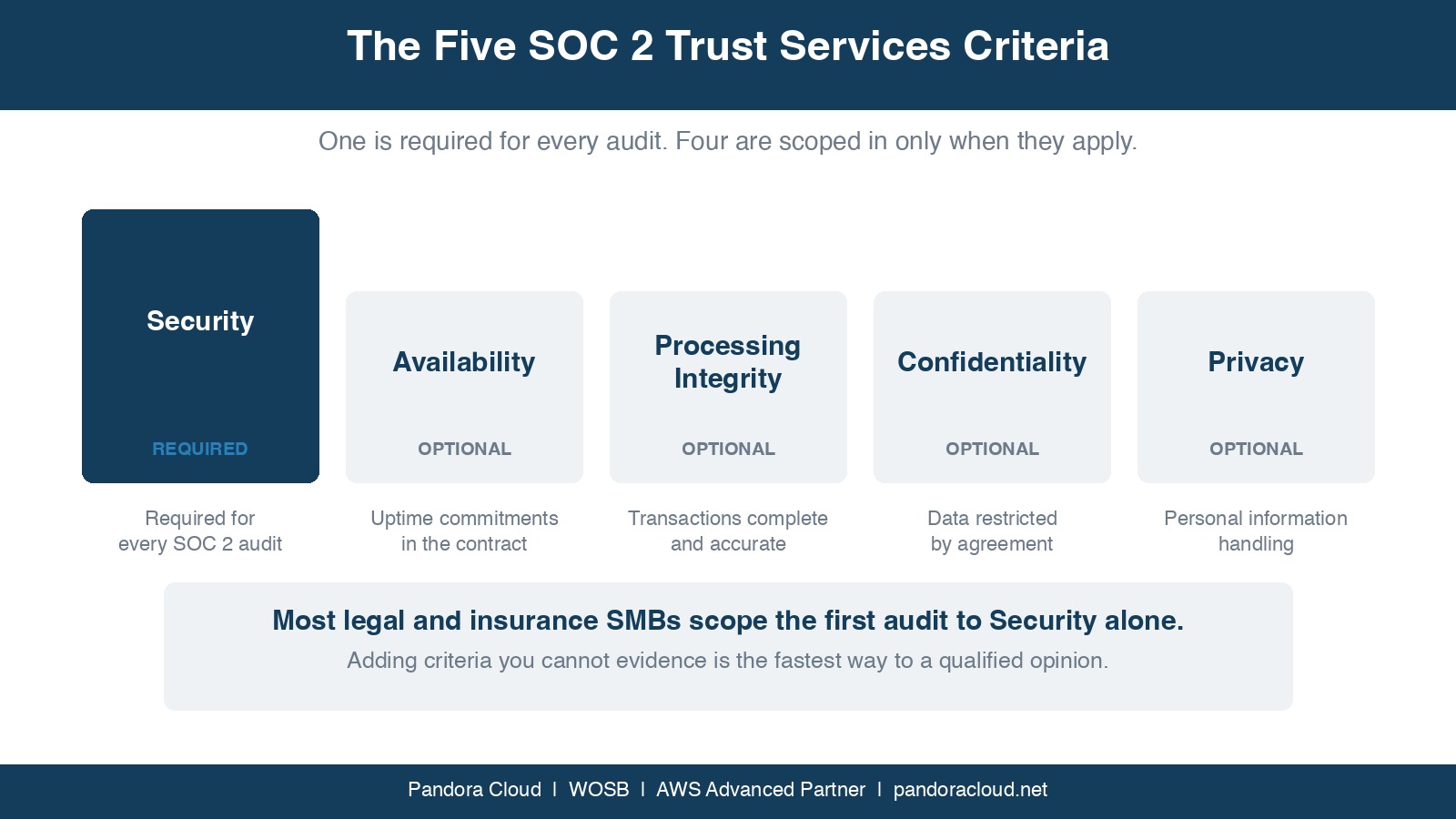
SOC 2 is an audit framework developed by the American Institute of Certified Public Accountants (AICPA). It evaluates how a service organization handles customer data across five trust services criteria: security, availability, processing integrity, confidentiality, and privacy. Security is required for every audit; the other four are optional, included only when they apply to the services being delivered.
There are two report types. A Type 1 report is a point-in-time snapshot: the auditor confirms that controls are designed correctly on a single date. A Type 2 report covers an audit window, typically 6 to 12 months, during which the auditor tests whether those controls actually operated as intended. Enterprise buyers almost always want Type 2 because it shows the controls work in practice. That is the version SOC 2 for legal and insurance vendors are usually asked to produce.
The deliverable is a report, not a certificate. The auditor writes an opinion, the controls are described, and the customer reads the whole thing to decide whether they trust the organization with their data. A clean opinion unlocks the contract; a qualified opinion can do as much damage as no audit at all.
Why Is SOC 2 for Legal and Insurance Different?
SOC 2 for legal and insurance starts from a common thread: both handle deeply sensitive client information, both operate under heavy regulatory pressure, and both depend on enterprise relationships that increasingly demand SOC 2. The specifics are where the two industries diverge, and where most generic SOC 2 advice falls short.
For legal SMBs, the controls have to coexist with attorney-client privilege, work product doctrine, and bar rules that vary by state. Document retention obligations differ across practice areas; matter-level access restrictions matter more than firm-wide ones; the audit evidence has to demonstrate that privileged information stayed inside the privilege boundary. A control that satisfies a software vendor will not necessarily satisfy a state bar reviewer or a malpractice underwriter.
For insurance SMBs, the regulatory landscape is a state-by-state patchwork. The National Association of Insurance Commissioners (NAIC) Insurance Data Security Model Law has been adopted in some form by 28 jurisdictions as of April 2026, with another pending and more states actively considering the framework. Carriers offering health-related products often cross into Health Insurance Portability and Accountability Act (HIPAA) territory and need Business Associate Agreements (BAAs) for downstream vendors. The volume of Personally Identifiable Information (PII) flowing through a small carrier or managing general agent is often larger than the team realizes.
SOC 2 for legal and insurance does not replace any of this; it sits alongside it. A well-built program produces most of the evidence that bar reviewers and state insurance regulators ask for anyway. Done well, it is leverage. Done poorly, it is a parallel binder that nobody trusts.
What Are the Five Misconceptions That Show Up in Every Engagement?
The same five misunderstandings appear over and over when firms first approach SOC 2 for legal and insurance work. Each one feels reasonable at first glance, and each one creates a gap that a skilled auditor finds within days.
1. “We do not store client data; we use cloud apps, so it is the vendor’s responsibility.”
Cloud applications run on a shared responsibility model. The vendor secures the platform; you secure how you configure it, who can access it, and what flows through it. Auditors look at your account configuration, your user access, your data export practices, and your downstream vendors. SOC 2 follows the data, not the data center.
2. “Our information technology contractor handles compliance.”
Information technology support and compliance ownership are different functions. A contractor who resets passwords and patches laptops is solving operational problems, not running a control framework. Compliance ownership means someone is accountable for policies, evidence collection, vendor reviews, and audit responses. Most legal and insurance SMBs discover late in the process that their information technology partner never agreed to own these responsibilities.
3. “Our policies have not changed, so we do not need to update anything.”
Auditors look for evidence that the policies match what the organization actually does. New tools, new vendors, new staff, new client types, and new state regulations all create drift. A policy library that has not been reviewed in 18 months almost always has gaps against the current environment, and those gaps become audit findings.
4. “We will handle SOC 2 after we close the deal.”
Most enterprise buyers will not wait. Procurement teams have standardized vendor questionnaires, and the SOC 2 question is often a hard gate. Even when a buyer gives a small firm extra time, the relationship starts in a remediation posture, which sets the tone for every renewal that follows. SOC 2 readiness is a sales asset, not a back-office task.
5. “SOC 2 is a one-time thing.”
SOC 2 Type II is an annual audit covering a continuous window. Controls have to operate every day across the window, evidence has to be collected continuously, and any gap shows up in the next report. Treating SOC 2 as a project produces one clean report and then a long, expensive scramble the following year.
What Are the Five Areas Where Legal and Insurance SMBs Have Real Gaps?
When a firm runs a readiness assessment for the first time, the same five categories produce most of the findings. These are the five places SOC 2 for legal and insurance most often comes apart. None of them are obscure; all of them are achievable with the right structure and a realistic timeline.
Access controls and audit logging. SOC 2 expects you to demonstrate, on demand, who accessed which client matter, policy file, or claim record and when. That requires unique user accounts, role-based permissions that reflect actual job duties, audit logs protected from tampering, and periodic reviews. Shared logins, generic admin accounts, and missing logs from older systems are the most common findings.
Vendor risk management. Lawyers and insurers accumulate a long tail of small vendors: e-discovery platforms, transcription services, claim adjuster tools, document review contractors, marketing automation, niche analytics. Many handle sensitive data without a BAA, a Data Processing Agreement (DPA), or a current security review. SOC 2 expects an inventory, a risk rating, and an annual review for every vendor that touches in-scope data. It is the single most common gap area in SOC 2 for legal and insurance engagements.
Change management. Small firms make changes ad hoc. A managing partner approves a new tool over coffee; an operations lead spins up a shared drive on a Friday; a principal signs a new vendor without a formal review. SOC 2 requires documented change control: a request, a review, an approval, and a record. The process does not have to be heavy, but it has to be consistent across the audit window.
Incident response readiness. Most small legal and insurance firms have never simulated a breach response. The plan, if one exists, lives in a document nobody has opened in a year. SOC 2 looks for a written plan, defined roles, regular tabletop exercises, and evidence the plan was actually used the last time something went wrong. State breach notification laws and bar reporting obligations add real urgency.
Continuous monitoring. Point-in-time policies do not survive a 12-month audit window. SOC 2 Type II expects ongoing evidence: monthly access reviews, quarterly vendor checks, configuration monitoring, log analysis, and proof that exceptions were caught and resolved. Firms that try to assemble this evidence three weeks before the audit closes usually produce a report with multiple observations.
What Is the Cost of Waiting?
SOC 2 for legal and insurance is a calendar problem before it is a budget problem, and the arithmetic is unforgiving. A Type II report covers an observation window during which controls have to operate and be tested, so no amount of urgency compresses it into a 60-day procurement gate. Readiness started early is what turns the next renewal into a checkpoint.
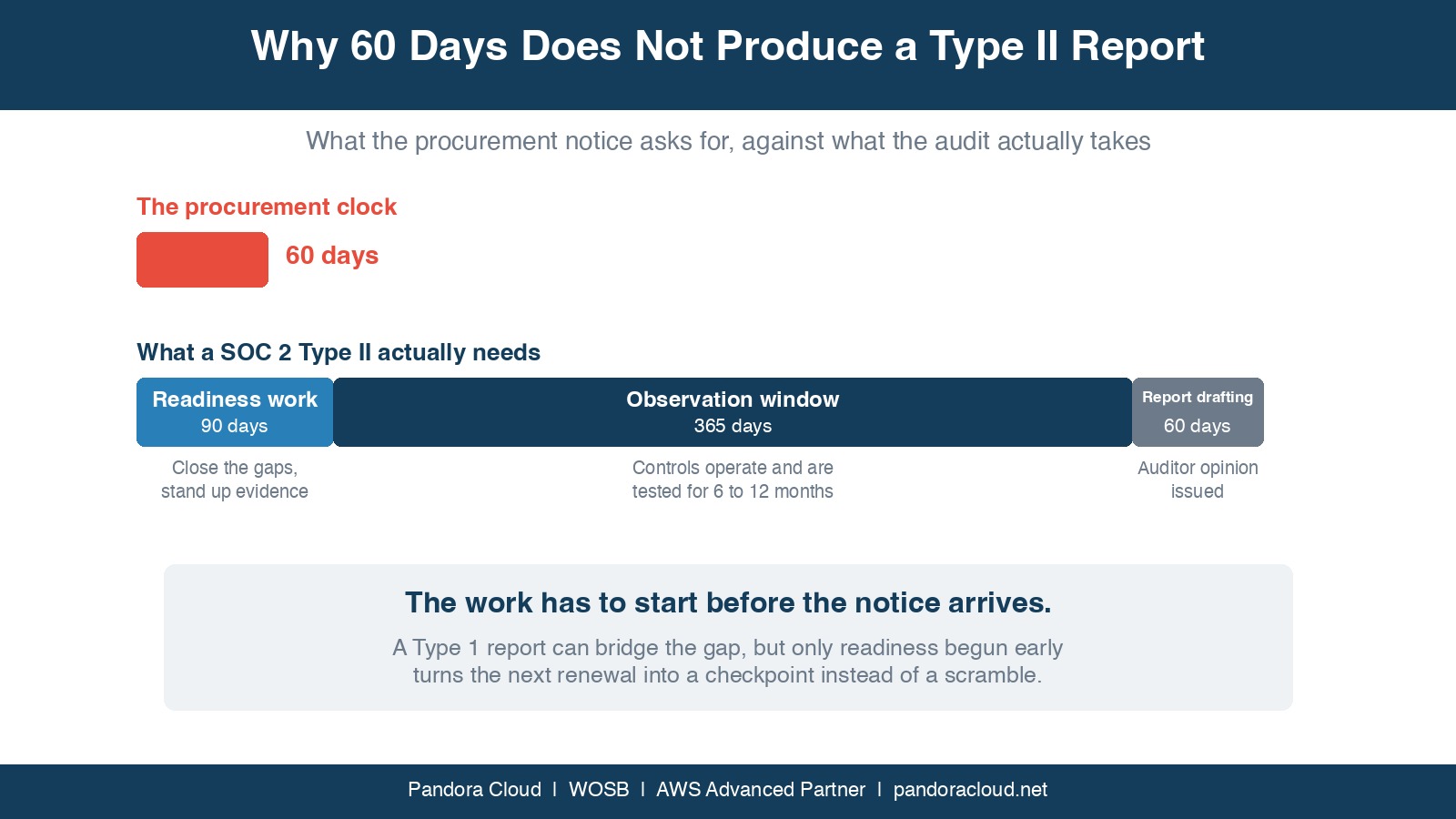
The cost of delay is rarely a single line item; it is a series of compounding ones. Failed or delayed audits push revenue into the next quarter, and procurement teams remember which vendors slipped. Lost deals go to competitors that can hand over a current report on day one. Cyber liability underwriters increasingly look for audit history, and a clean SOC 2 report can move a premium in the right direction.
For insurance SMBs specifically, regulators are already enforcing. In October 2025 the New York State Department of Financial Services collected more than 19 million dollars from eight auto insurers that had failed to implement the safeguards its cybersecurity regulation requires, and two of them were additionally cited for not reporting the incident on time. The penalty is only part of the cost; a consent order follows the firm into every future filing.
Reputational damage is harder to undo. A firm that suffers a public incident with no documented control framework spends the next two years answering the same question from every prospective client. A firm with a current SOC 2 report and a remediation plan answers it once.
For context on running compliance as an operational function rather than an annual scramble, our Compliance Program Blueprint walks through the structure SMBs use to keep multiple frameworks current at the same time.
Where Do You Get the SOC 2 Readiness Checklist?
If you want a focused starting point for SOC 2 for legal and insurance, we built a free SOC 2 Readiness Checklist. It walks through the trust services criteria, the audit prep timeline, the documentation you need before the auditor arrives, and the most common findings flagged during a Type II window.
Each item is written for a managing partner, principal, or operations lead, not a security engineer. You can work through it with your team in an afternoon and come out with a clear list of what is in place, what is partial, and what needs attention before the next enterprise client asks for a report.
Download the free SOC 2 Readiness Checklist
If you are a fintech rather than a law firm or an agency, SOC 2 is usually the first of several frameworks a bank or payments partner will ask for. The free Fintech Compliance Crosswalk maps SOC 2, the Payment Card Industry Data Security Standard (PCI DSS), the Gramm-Leach-Bliley Act (GLBA) Safeguards Rule, the New York Department of Financial Services (NYDFS) Part 500 regulation, and Sarbanes-Oxley (SOX) IT general controls to one control set, so the SOC 2 work you do now earns credit in every framework that follows.
What Does SOC 2 Compliance Actually Cost?
SOC 2 for legal and insurance is a budget conversation, especially when the alternative is losing enterprise deals. Our free Cost Calculator compares the cost of building SOC 2 in from the start versus catching up under a 60-day procurement clock. Pick your firm size, the trust services criteria your clients care about, and a time horizon, and see what each path costs your practice.
Key Takeaways
- SOC 2 Type II is not a certificate; it is an auditor’s opinion covering 6 to 12 months of continuous control operation, and a qualified opinion can do as much damage to enterprise relationships as no audit at all.
- In SOC 2 for legal and insurance work, controls must coexist with attorney-client privilege, work product doctrine, and state bar rules; a control that satisfies a software vendor will not necessarily satisfy a malpractice underwriter or a bar reviewer.
- The NAIC Insurance Data Security Model Law has been adopted in 28 jurisdictions as of April 2026, and regulators are enforcing: New York’s Department of Financial Services collected more than 19 million dollars from eight auto insurers in October 2025 over cybersecurity control failures.
- Vendor risk management is the most overlooked gap area in legal and insurance SMBs; e-discovery platforms, transcription services, claim adjuster tools, and document review contractors all require an annual security review and a current Data Processing Agreement or BAA.
Next Steps
SOC 2 for legal and insurance firms is achievable at SMB scale, but the path is operational, not transactional. The firms and carriers that get it right treat SOC 2 as the natural output of a working compliance program, not a project bolted onto a busy quarter.
Pandora Cloud handles SOC 2 for legal and insurance end to end, building SOC 2-ready cloud environments and operating them through every audit window. We combine continuous monitoring with managed compliance services, so your team can focus on clients while we handle the infrastructure and the evidence trail.
Take our free compliance assessment to see where your environment stands today, or let’s talk through your specific situation.
