
A Small Business Innovation Research (SBIR) Phase 2 awardee finishes month five of a 24-month contract. Her team has built a working prototype in a developer cloud account, demoed it twice to the program office, and just discovered that none of the work transfers to a compliant environment. The Authorizing Official (AO) her customer assigned will not authorize the prototype. The team has 19 months left to rebuild in a compliant landing zone, complete the authorization, integrate with mission systems, and deliver. The prototype that took five months becomes a sunk cost.
This is the SBIR compliance trap. It does not look like a trap from inside; it looks like normal startup velocity. The team built fast, validated the technical concept, and is ready to scale. The compliance work was supposed to come later. The customer was supposed to give the team time. Neither of those assumptions survives contact with a federal authorization.
The SBIR program is designed to accelerate commercialization of technology with federal applications. The program funds the technology; it does not fund the compliance infrastructure required to deploy it. That SBIR compliance gap, between funding-to-prototype and prototype-to-delivery, is where a substantial fraction of Phase 2 awards stall, slip, or fail to reach Phase 3 commercialization. The teams that finish on time understand the SBIR compliance gap and architect around it from day one. With SBIR and Small Business Technology Transfer (STTR) reauthorized through 2031 in April 2026 after a six-month lapse, new Phase 2 awards are flowing again; the compliance gap below is what turns them into deliveries.
What you’ll learn: Why SBIR funding covers technical development but not the compliance infrastructure required to deploy in a federal environment, the five pitfalls that each add six or more months to a delivery date, and the 90-day compliance foundation plan that lets the authorization clock run parallel to technical development.
What Does the SBIR Award Pay For (and What Does It Not)?
SBIR funding pays for technical development. Salaries, prototype costs, customer engagement, and direct technical work all map cleanly to the contract budget. What the contract does not natively cover is the compliance infrastructure required to deploy the technology in a federal environment: the compliant landing zone, the Authority to Operate (ATO) process, the application-specific control implementation, the inheritance documentation, and the ongoing continuous monitoring.
Some teams negotiate cloud and compliance costs into the budget; most do not, because most teams do not know to ask. The cost shows up at month four or five, when the team realizes the technology cannot be delivered into the customer’s environment without additional infrastructure work. That work was not budgeted. Now the team is in a difficult conversation with the customer about scope.
The fix is not asking for more money. The fix is recognizing the compliance scope on day one and architecting the technology to fit a known compliance boundary, so the integration work is bounded and predictable.
Why Is the SBIR Compliance Trap the Hidden Critical Path?
Defense and federal customers do not run unauthorized software in production. The Authorizing Official cannot accept the risk; the program office cannot approve the deployment. Until the application has a current ATO at the right Impact Level (IL), it is a science project, no matter how well it works.
Authorization is not a paperwork step at the end of the project. It is roughly a 90-day path to authorized operations when the work runs in parallel with technical development inside an already-authorized landing zone; a cold-start Impact Level authorization, where the team builds the environment and carries it through the Cloud Service Provider Security Requirements Guide assessment and a Mission Owner’s Authority to Operate on its own, runs 12 to 18 months. The architecture decisions made in month one determine how achievable that timeline is. Build outside a compliant boundary and the authorization clock cannot start; build inside one and the clock starts on day one.
This is the calculation that flips the strategy. Compliance is not the gate at the end; it is the foundation under everything. The teams that ship on time put the compliance foundation in place first and build the technology on top of it. The teams that miss their dates build the technology first and try to bolt on compliance after.
What Are the Five Pitfalls Behind the SBIR Compliance Trap?
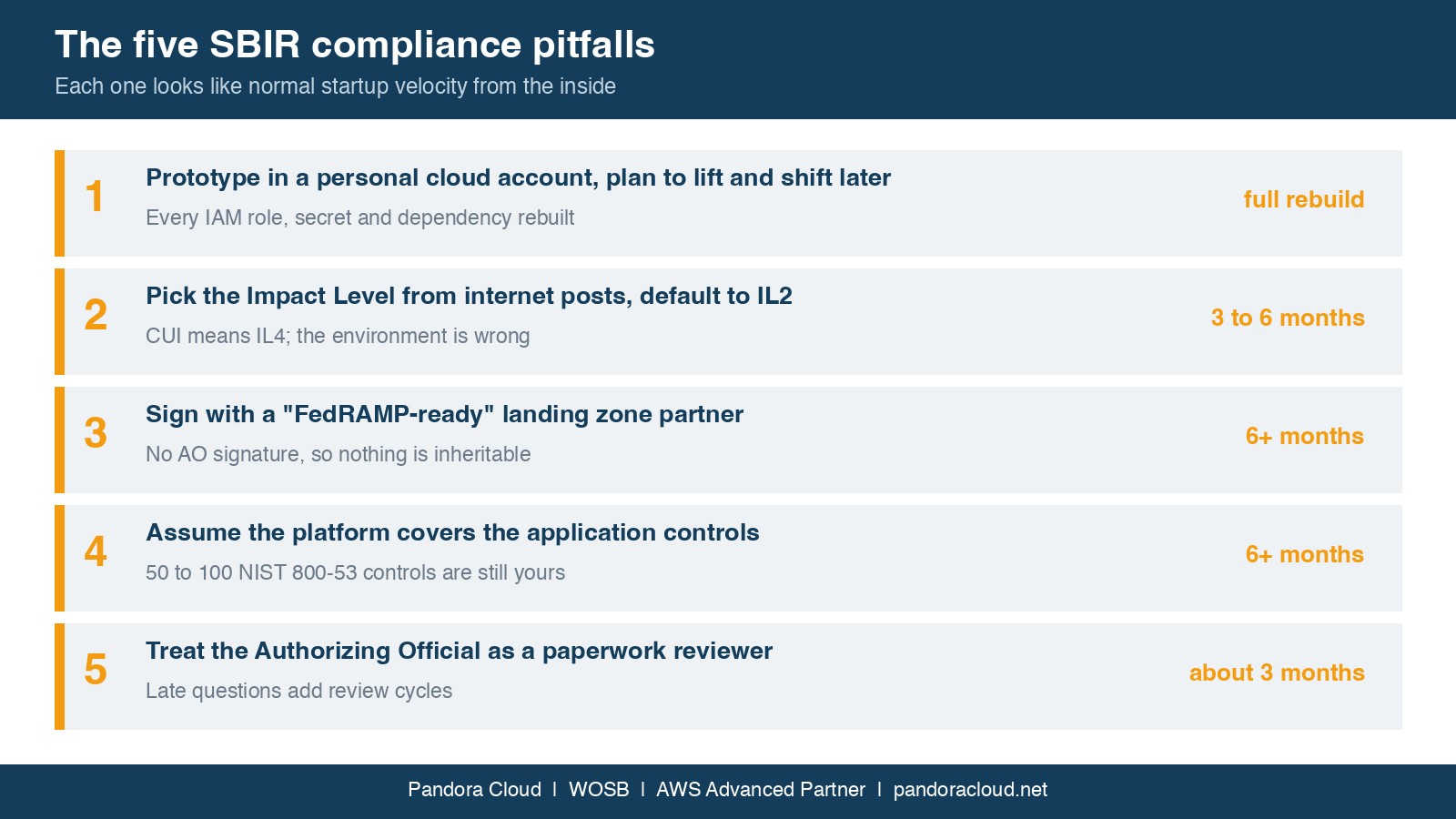
The same five SBIR compliance failures show up across awards in defense, intelligence, and federal civilian agencies. Each one feels like a sensible startup decision; each one extends the delivery date by six months or more.
1. Treating the prototype environment as the production path. A team builds in a personal cloud account or a generic startup tier because it is fast and inexpensive. The work produces a great demo, and at month four the team plans to “just lift and shift” into a compliant environment. The lift-and-shift is a full rebuild: every Identity and Access Management (IAM) role rewritten, every secret rotated, every architectural decision re-examined under the compliance lens, every dependency revalidated. Plan to deliver from a compliant environment from week one.
2. Choosing the Impact Level by reading internet posts. The teams that get this wrong typically default to IL2 because it is cheaper and faster to stand up, only to discover at month five that the data they handle is Controlled Unclassified Information (CUI), which requires IL4 or higher. The remediation costs three to six months and a substantial budget hit. The Impact Level should be confirmed in writing with the program office and the data owner before any infrastructure decision.
3. Picking a “Federal Risk and Authorization Management Program (FedRAMP)-ready” landing zone partner. The marketing language is similar to “FedRAMP-authorized” and the difference is significant. FedRAMP-ready means the partner is preparing for authorization but does not yet have an Authorizing Official’s signature. Inheriting from a FedRAMP-ready environment is not real inheritance; the controls are not yet validated, the continuous monitoring is not in place, and the Authorizing Official will not accept the inheritance. Confirm the FedRAMP authorization status, the Impact Level, and the agency sponsor before signing anything.
4. Underestimating the application-specific control burden. Even with strong inheritance from a compliant landing zone, the application team owns roughly 50 to 100 application-specific controls under the National Institute of Standards and Technology Special Publication 800-53 (NIST 800-53) Revision 5. Identity provisioning, role-based access for application users, application-level logging, change control, customer notification procedures, and incident response specific to your workload. Teams that scope this in week one finish on time; teams that discover it in month eight do not.
5. Treating the Authorizing Official as a paperwork reviewer. The Authorizing Official is a senior federal employee with personal accountability for the risk decision. They are not a checklist verifier; they are a risk manager who needs to understand the system, the threats, and the controls in operational terms. Teams that engage the Authorizing Official late produce a perfect package and discover the AO has questions that take three months to answer. Teams that engage the Authorizing Official early build the package around the AO’s actual concerns and finish in a single review cycle.
What Is the 90-Day Compliance Foundation?
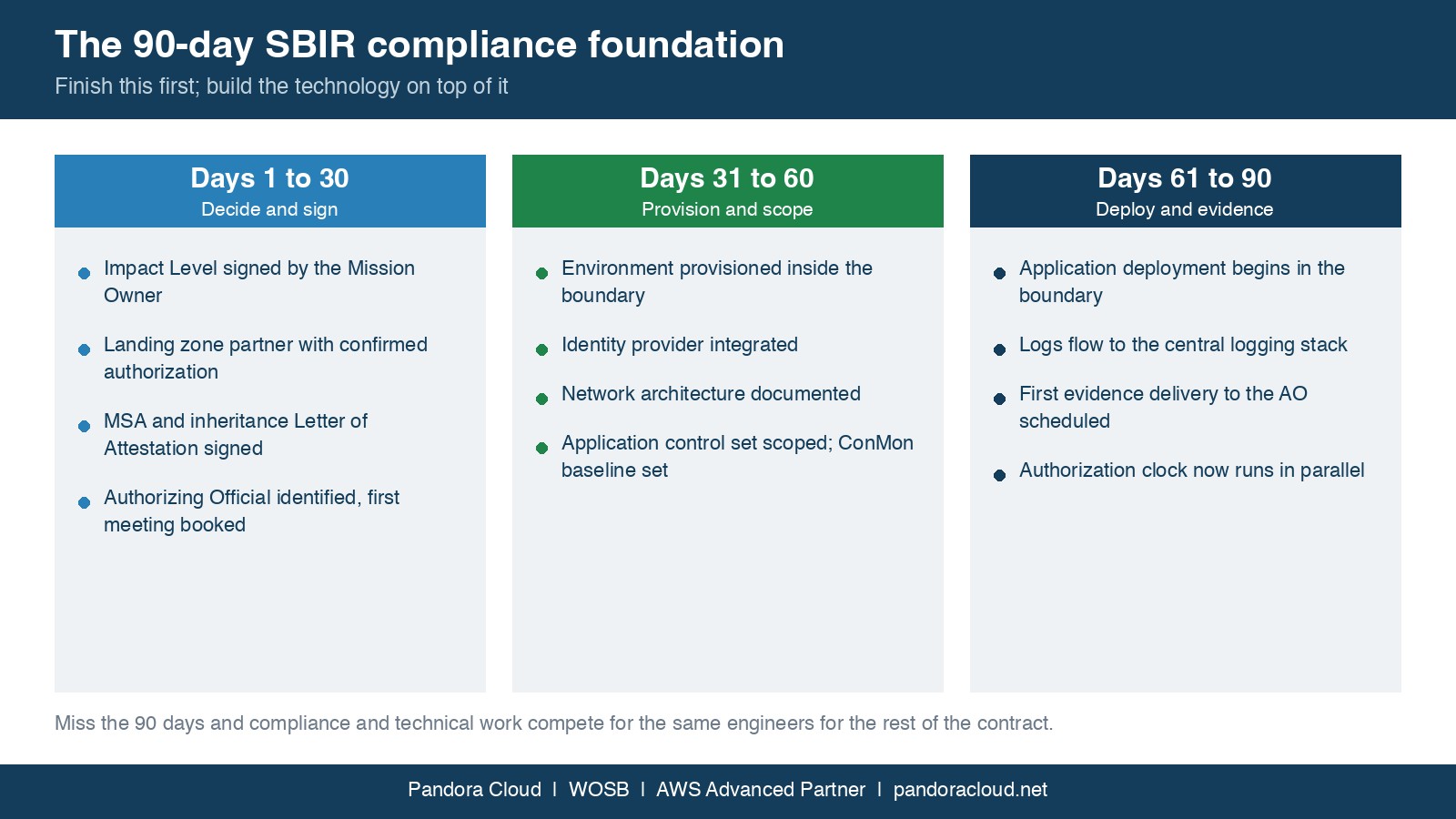
A successful SBIR delivery establishes the SBIR compliance foundation in the first 90 days, then builds the technology on top of it. The 90-day plan is not aspirational; it is operationally achievable for any team with a clear-eyed scope and a partner who has done it before.
Days 1 to 30: Impact Level determination signed by the Mission Owner or contracting officer. Compliant landing zone partner selected with confirmed FedRAMP authorization at the right level. Master Service Agreement and inheritance Letter of Attestation signed. Authorizing Official identified, with introductory meeting on the calendar.
Days 31 to 60: Environment provisioned. Identity provider integrated. Network architecture documented. Application-specific control set scoped. Continuous monitoring baseline established with the platform partner.
Days 61 to 90: Application deployment begins inside the compliant boundary. Application logs flow to the centralized logging stack. First evidence delivery to the Authorizing Official scheduled. The team that gets here on time can spend the rest of the contract on technical work, knowing the authorization is on a known path. The team that has not finished this in 90 days is fighting compliance and technical work in parallel for the rest of the contract.
Where Do You Get the SBIR Compliance Sprint Plan?
If you are starting an SBIR contract or evaluating compliance scope mid-contract, we built a free SBIR Compliance Sprint Plan. It is a 90-day timeline from contract award to authorized deployment, with phase gates, decision points, the documents to sign, and the meetings to schedule across each 30-day block. It is the same plan we use with the defense and federal-facing teams we work with.
Each step is written for a Principal Investigator, founder, or technical lead, not a federal compliance specialist. You can adapt it to your specific contract type, Impact Level, and customer agency, and use it as the project plan for your compliance workstream.
Download the free SBIR Compliance Sprint Plan
For the architectural treatment of how to actually build inside a compliant landing zone, our Mission App Builder Guide walks through the inheritance map, the application-specific control set, and the technical decisions that make the 90-day plan executable. The Sprint Plan and the Builder Guide pair naturally for SBIR teams.
Where CMMC Level 2 Stands Right Now
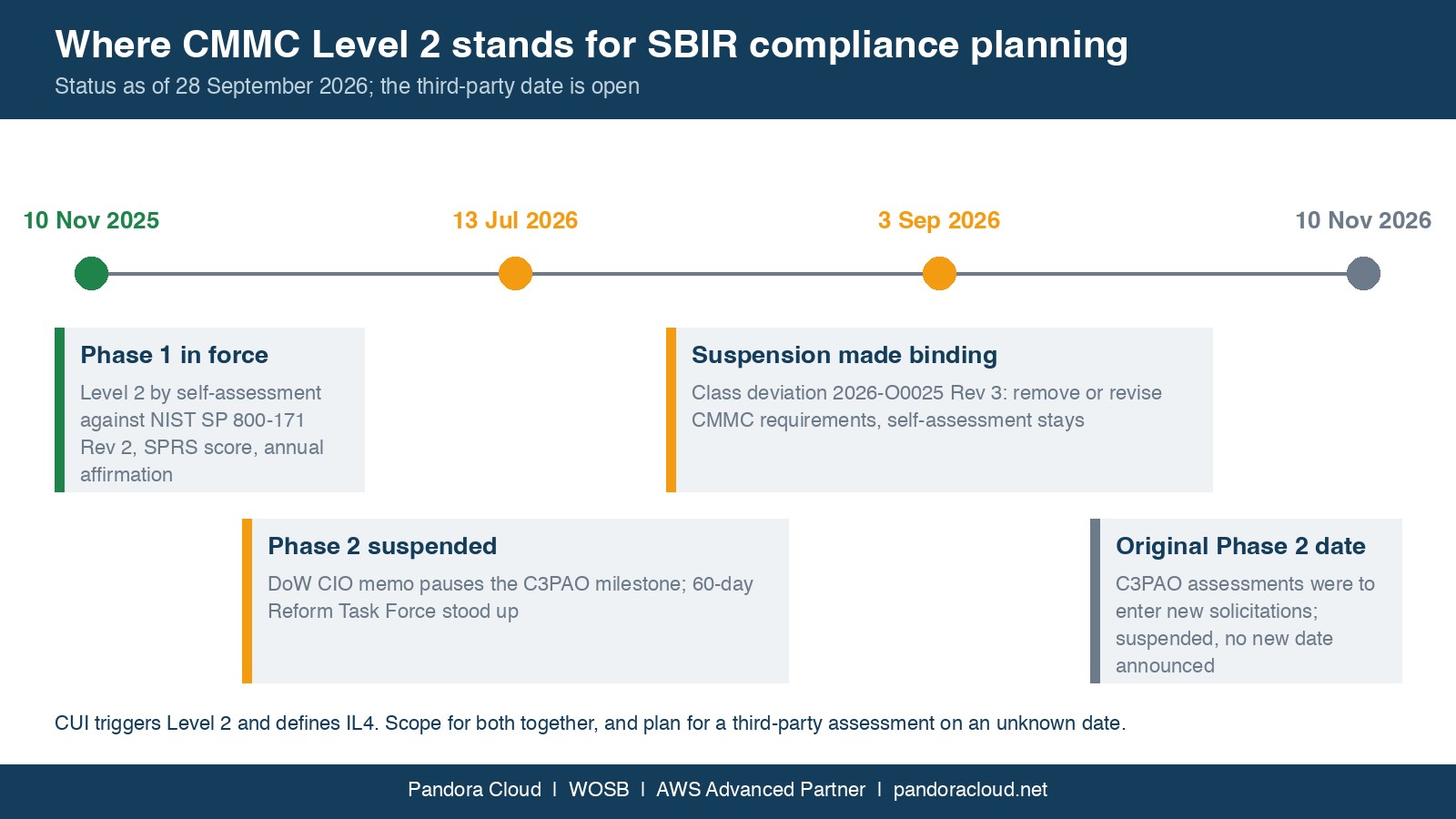
Cybersecurity Maturity Model Certification (CMMC) Level 2 is already in Department of Defense contracts. Phase 1 of the rollout took effect on November 10, 2025: applicable solicitations carry Defense Federal Acquisition Regulation Supplement (DFARS) clause 252.204-7021, and Level 2 is satisfied today by a self-assessment against NIST Special Publication 800-171 Revision 2, a score posted to the Supplier Performance Risk System (SPRS), and an annual affirmation by a company official. None of that is suspended.
What changed is the second step. Phase 2 was scheduled to begin on November 10, 2026, when new solicitations would start requiring a Level 2 assessment by a CMMC Third-Party Assessment Organization (C3PAO) instead of a self-assessment. On July 13, 2026 the Department suspended that milestone and stood up a 60-day CMMC Reform Task Force. The suspension has since hardened: class deviation 2026-O0025 Revision 3, signed September 3, 2026, directs contracting officers to work with requiring activities to remove or revise CMMC requirements in new and existing solicitations and contracts, leaving only Level 1 and Level 2 self-assessments in place. That is a binding regulation rather than a policy pause, and reversing it takes more than a memo.
The task force report was due to the Department’s Chief Information Officer on September 11, 2026; as of this writing it has not been made public and no new Phase 2 date has been announced. Plan for a third-party assessment on an unknown date, not a fixed one.
This matters for SBIR compliance planning specifically because of how the levels map to data. CMMC Level 1 covers Federal Contract Information only. The moment your work touches Controlled Unclassified Information (CUI), you are in Level 2 territory, and CUI is also what defines Impact Level 4 under the Department of Defense Cloud Service Provider Security Requirements Guide. If your environment needs IL4, your organization needs Level 2. The two travel together, and teams that scope for one while planning for the other discover the gap during the assessment rather than before it.
A C3PAO assessment cannot be booked and completed in a fortnight, and the assessor pool is small relative to the number of contractors that will need one when the milestone returns. If your SBIR Phase 2 runs into 2027 and touches CUI, the sequencing work in the previous section is not a nice-to-have; it is the SBIR compliance work that determines whether you are assessable when a contract requires it, on whatever date that turns out to be.
How Do You Run Your Own SBIR Math?
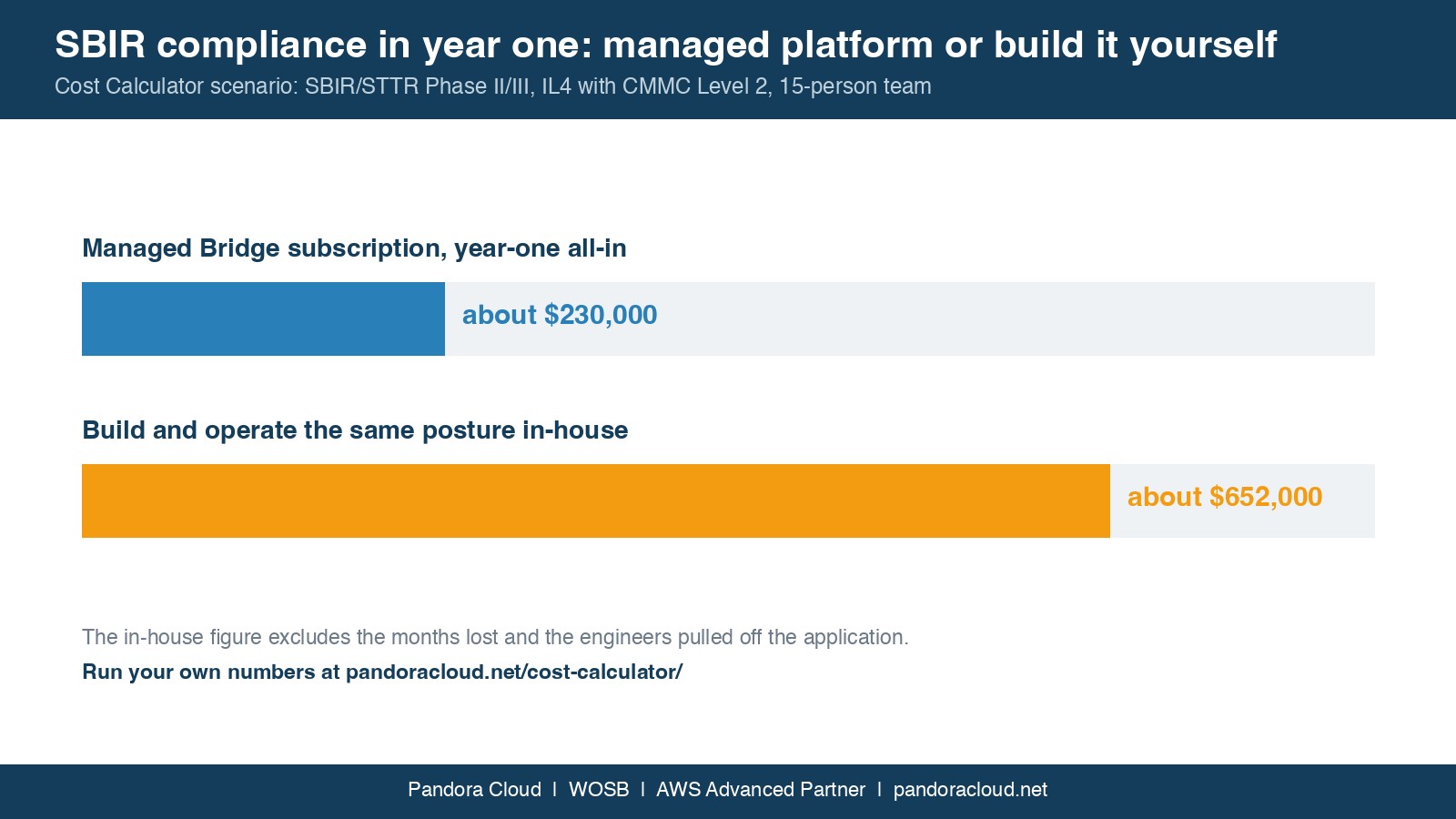
A managed Bridge subscription year-one all-in for a typical SBIR Phase 2 program at Impact Level 4 with CMMC Level 2 lands at roughly $230,000. Building and operating the same posture in-house runs about $652,000 across the same window, before counting the lost months and the engineers diverted from the application. Our free Cost Calculator includes an SBIR/STTR Phase II/III scenario built around exactly this audience. Plug in your contract scope, framework mix, and time horizon, and see the side-by-side comparison before you commit to a path.
Key Takeaways
- CMMC Level 2 is already in Department of Defense contracts as a self-assessment (Phase 1, in force since November 10, 2025). The shift to mandatory C3PAO assessments, originally set for November 10, 2026, was suspended on July 13, 2026 and locked in by a binding class deviation on September 3, 2026, with no new date announced. Level 2 is triggered by CUI, the same data class that defines IL4; teams scoping for IL4 while planning for Level 1 will find the gap during the assessment.
- Authorization is not a paperwork step at the end of the project; it is roughly a 90-day path to authorized operations when it runs in parallel with technical development inside an already-authorized landing zone; a cold-start Impact Level authorization, where the team builds the environment and carries it through the Cloud Service Provider Security Requirements Guide assessment and a Mission Owner’s Authority to Operate on its own, runs 12 to 18 months. The architecture decisions made in week one determine whether that timeline is achievable.
- A prototype built outside a compliant boundary cannot be “lifted and shifted”; every IAM role must be rewritten, every secret rotated, and every architectural decision re-examined under the compliance lens, turning a one-time migration into a full rebuild.
- A managed Bridge subscription for a typical SBIR Phase 2 program at IL4 with CMMC Level 2 runs approximately $230,000 year-one all-in, against roughly $652,000 to build and operate it yourself, before counting diverted engineering hours.
- Even with strong platform inheritance, the application team owns roughly 50 to 100 NIST 800-53 Rev 5 application-specific controls; teams that scope this in week one finish on time; teams that discover it in month eight do not.
Next Steps
The SBIR compliance trap is not a technical problem; it is a sequencing problem. Teams that put the compliance foundation first and build the technology on top hit their delivery dates. Teams that build first and bolt on compliance after rarely do. The difference is not engineering talent or contract size; it is the decision tree the team follows in week one.
Pandora Cloud builds and operates FedRAMP-aligned cloud landing zones at IL2, IL4, and IL5 for SBIR teams and small defense contractors. Your application inherits the cloud-provider controls; Pandora Cloud operates the FedRAMP-aligned platform layer, the inheritance documentation, the Authorizing Official engagement, and the continuous monitoring, so your engineers can focus on the technology and your delivery date stays achievable.
If you want to walk through your contract scope and see what the 90-day plan would look like for your specific Impact Level, let’s talk.
