
A procurement officer at a regional healthcare network reviews three vendor proposals for a managed cloud migration. The largest national firm has the recognizable brand. A mid-tier generalist has the lowest price. The third proposal is from a Woman-Owned Small Business (WOSB) cloud partner with a focus on regulated industries. Going in, he ranks the WOSB firm third on brand and assumes it is the convenient diversity-spend tick-box for the procurement scorecard. Diversity, trust, and compliance sit in three separate columns on his sheet.
By the end of the technical review, his read has flipped and the smaller firm is ranked first. It produced more current attestations, more specific architecture references, and more concrete answers about Health Insurance Portability and Accountability Act (HIPAA) Business Associate Agreement (BAA) coverage than either of the larger firms. The diversity certification turned out to be the thing he paid least attention to once the technical conversation began, which is the point of this post: diversity, trust, and compliance are not three separate questions for a procurement team. They are one.
This pattern is not unusual. Diverse-owned cloud partners, particularly those certified through Woman-Owned Small Business, Minority Business Enterprise (MBE, certified by the National Minority Supplier Development Council rather than the SBA), Service-Disabled Veteran-Owned Small Business (SDVOSB), Historically Underutilized Business Zone (HUBZone), and the Small Business Administration’s 8(a) Business Development Program, frequently demonstrate stronger compliance discipline than the bigger generalist alternatives. The certifications themselves do not mandate technical excellence, but the operating posture that earns and maintains them tends to produce it.
What you’ll learn: Why diversity, trust, and compliance converge in a cloud partner evaluation: why the administrative discipline required to maintain federal diversity certifications like WOSB and 8(a) produces an operational compliance posture that translates directly to regulated cloud work, and the five specific behaviors that distinguish strong diverse-owned cloud partners from firms that just hold the certification.
What Do Diversity Certifications Actually Require?
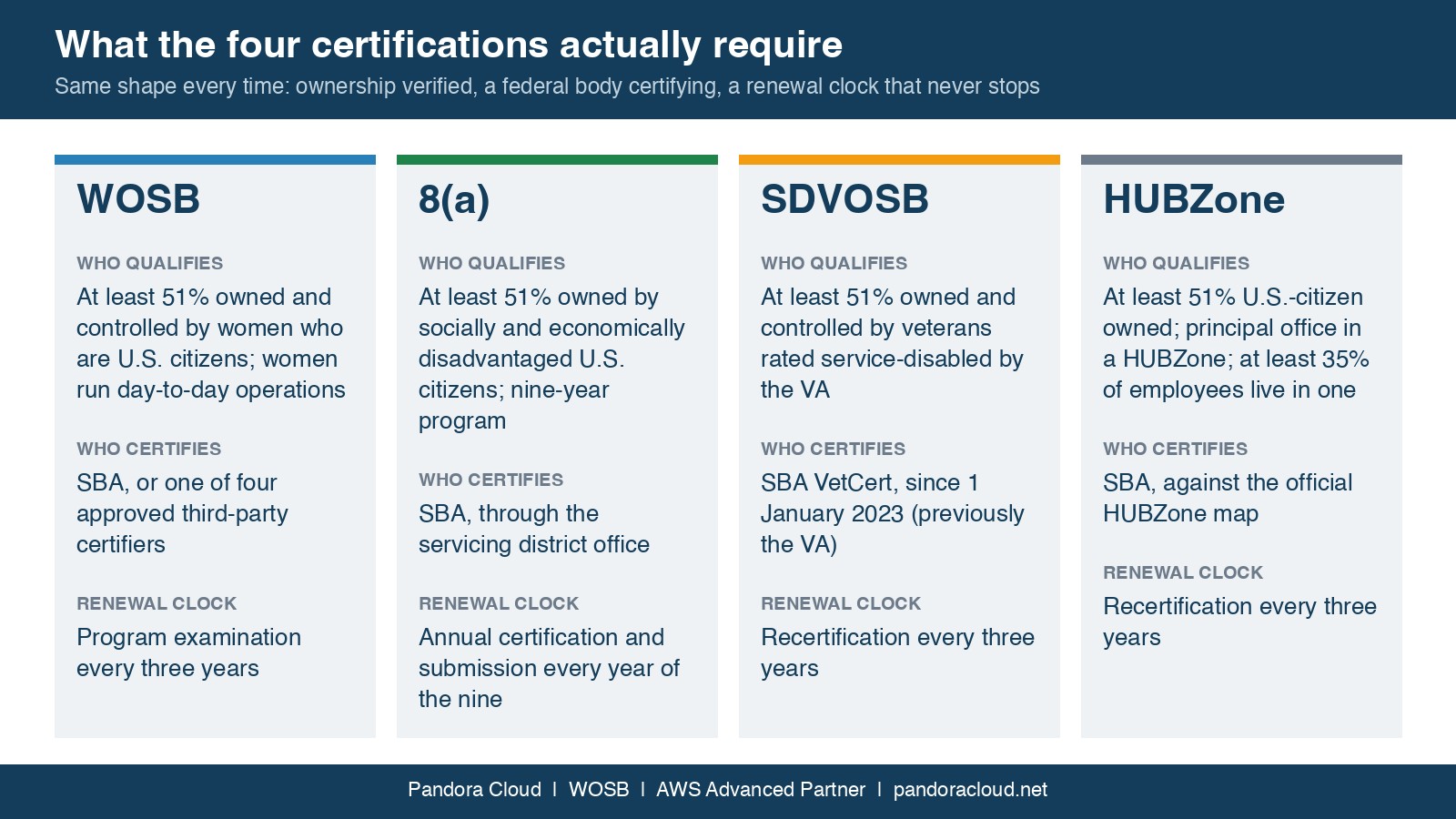
Each certification has its own qualifying criteria, but they share a common shape. WOSB certification, administered through the Small Business Administration (SBA), requires a business to be at least 51 percent owned and controlled by women who are United States citizens. The qualifying owner must run the day-to-day operations and make long-term strategic decisions. Verification involves financial records, organizational documents, ownership history, and personal financial disclosures from the qualifying owner.
The 8(a) Business Development Program is a nine-year program for socially and economically disadvantaged small businesses. Annual reviews require detailed business plans, performance metrics, and proof of continued eligibility. The program changed in 2026: since September 10, individually owned applicants prove social disadvantage with documented evidence rather than a group presumption, and SBA’s records audit earlier in the year suspended or moved to termination roughly a quarter of participants, so an 8(a) status is worth checking for currency, not just its entrance date. SDVOSB requires service-connected disability documentation, ownership and control verification, and ongoing reporting. HUBZone requires business location verification, employment-residency documentation, and continuous geographic compliance, with recertification every three years and continuous compliance maintenance between cycles.
These programs are not lightweight, and they are where diversity, trust, and compliance first intersect. The administrative discipline required to qualify, maintain, and renew certifications produces an organizational habit that translates directly to compliance work. A firm that has stayed compliant with a federal certification program for five years has demonstrated, in the most boring possible way, that it can keep documentation current, respond to audits, and operate within a rules-driven framework. Those are the same muscles a regulated cloud customer needs.
Why Do Diversity, Trust, and Compliance Matter for Regulated SMBs Choosing a Cloud Partner?
A regulated Small or Medium-sized Business (SMB) buying managed cloud services is taking on the partner’s compliance posture as part of its own. If the partner cannot produce a current System and Organization Controls 2 (SOC 2) Type II report, an up-to-date BAA, or evidence of ongoing security monitoring, the buyer inherits the gap. Auditors do not differentiate; the customer signed the contract.
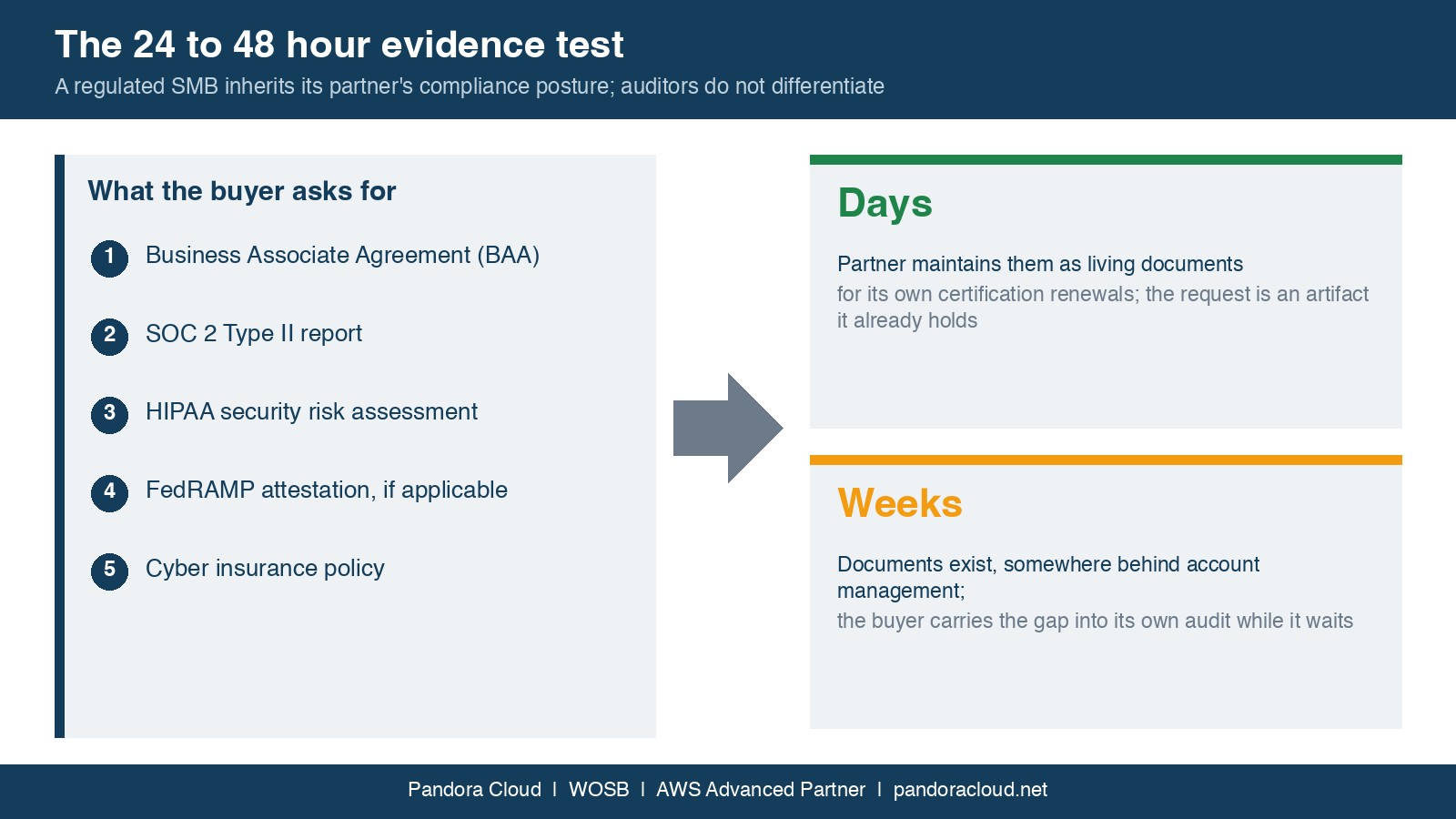
The bigger firm with a recognizable brand often has these documents, but they live behind layers of account management and may take weeks to surface. The diverse-owned partner that operates at SMB scale produces them in days because their entire client list is at SMB scale and the partner cannot afford to be slow about evidence requests. The compliance posture is not just present; it is operationalized. Diversity, trust, and compliance converge at exactly this point: the certification is the diversity signal, the evidence is the compliance signal, and the speed of producing it is where trust is earned.
This is not an argument for choosing a partner because of a certification. It is an argument for evaluating partners on operational discipline and recognizing that diverse-owned partners often perform well on that axis for structural reasons.
What Are the Five Things Strong Diverse-Owned Cloud Partners Do Differently?
The strongest diverse-owned cloud partners share five operational habits that show up in the way they engage with regulated SMB customers. None of them are exclusive to diverse-owned firms, but they tend to cluster there for the structural reasons described above. Each one is a place where diversity, trust, and compliance show up as a single operational behavior rather than three claims.
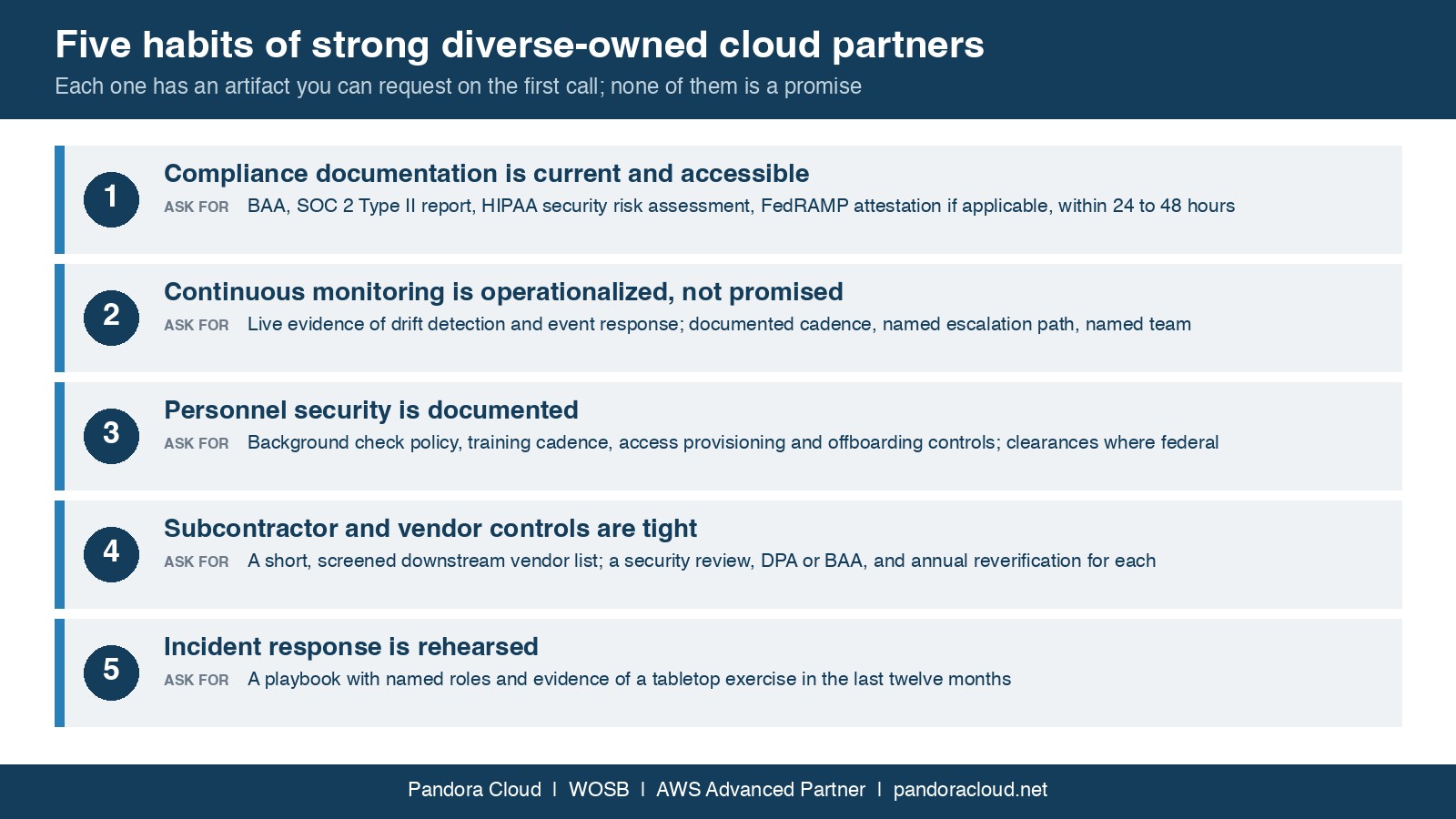
1. Compliance documentation is current and accessible. The BAA, the SOC 2 Type II report, the HIPAA security risk assessment, and the Federal Risk and Authorization Management Program (FedRAMP) attestation if applicable are produced within 24 to 48 hours of a request, not at the end of a multi-week procurement cycle. The partner has these documents because the partner needs them for their own certification renewals; the buyer is asking for an artifact the partner already maintains. This is the first place diversity, trust, and compliance can be checked with a date stamp.
2. Continuous monitoring is operationalized, not promised. The partner can show real-time evidence of how it monitors customer environments, flags configuration drift, and responds to security events. The reporting cadence is documented, the escalation paths are defined, and the team running the monitoring is named. Generic claims about 24-7 monitoring are not compelling without operational specifics.
3. Personnel security is documented. The partner publishes its background check requirements, training cadence, access provisioning procedures, and offboarding controls. For partners working with federal customers, clearances are documented and current. For partners handling Protected Health Information (PHI), HIPAA training compliance is verifiable. This is the boring documentation that bigger partners often deflect; smaller partners maintain it because audit failure is existential. Personnel files are where diversity, trust, and compliance meet the people doing the work.
4. Subcontractor and vendor controls are tight. The partner’s downstream vendor list is short, screened, and documented. Each downstream vendor that touches customer data has a current security review, a Data Processing Agreement (DPA) or BAA, and an annual reverification. A partner who cannot name their downstream vendors at the kickoff meeting is not a partner who has thought through the compliance perimeter.
5. Incident response is rehearsed. The partner has run tabletop exercises in the last twelve months, has a documented playbook with named roles, and can produce evidence of the most recent rehearsal. Customers ask for this evidence after their first incident, by which point it is too late to build it. The partner that has rehearsed before the incident handles it; the partner that has not, scrambles. Rehearsal is where diversity, trust, and compliance stop being a scorecard and become a practice.
How Do You Evaluate Diversity, Trust, and Compliance in a Cloud Partner?
Three categories matter when evaluating a diverse-owned cloud partner for a regulated workload, and together they cover diversity, trust, and compliance. The certifications matter for the procurement scorecard, but the operational evidence matters for whether the partner will keep the customer compliant.
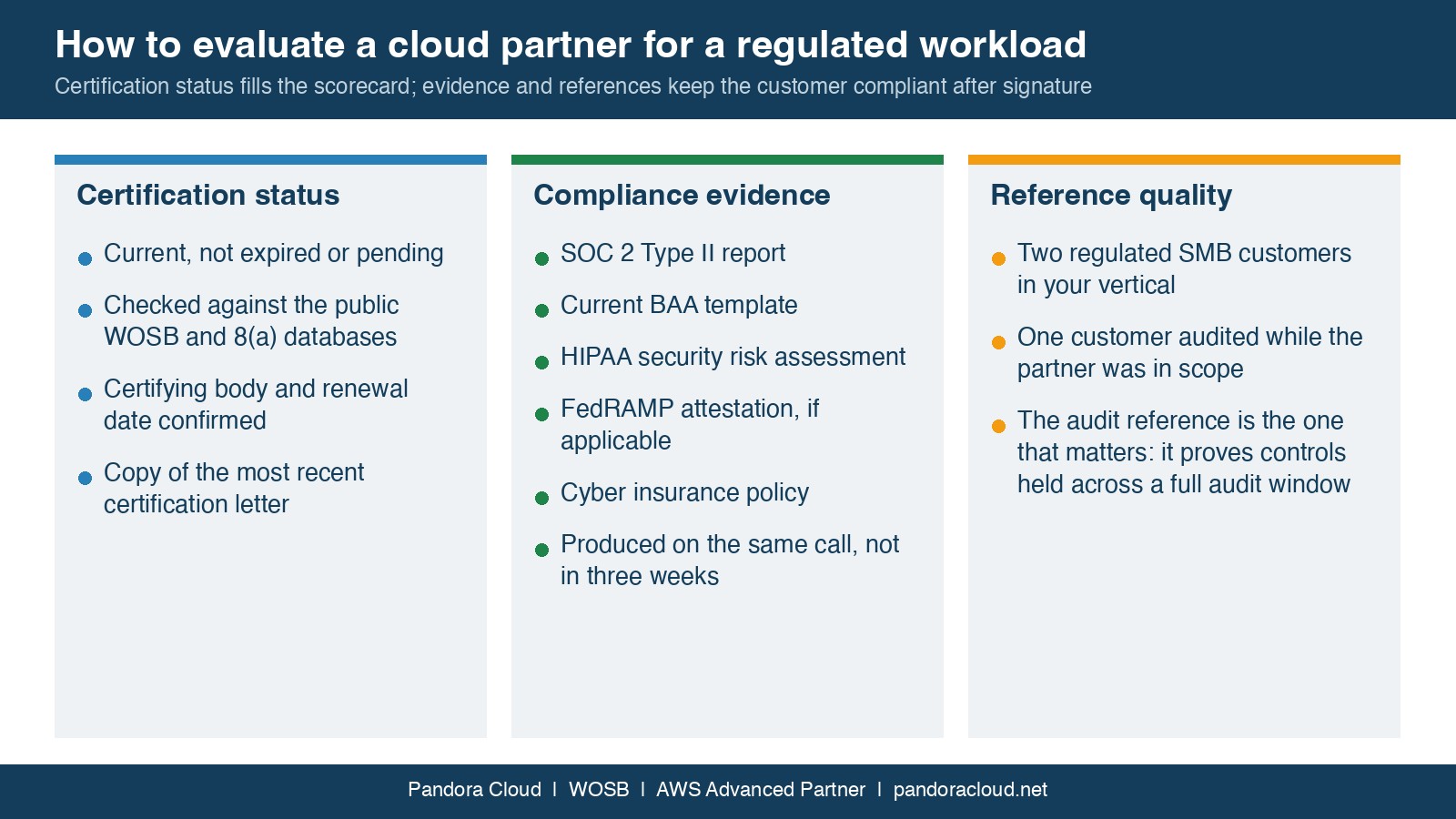
Certification status. Verify the certifications are current, not expired or pending. SBA’s Small Business Search, which replaced the Dynamic Small Business Search in July 2025 and draws on SAM.gov, lists WOSB, 8(a), HUBZone, and SDVOSB status publicly. Confirm the certification body and the renewal date. Ask for a copy of the most recent certification letter.
Compliance evidence. Request the SOC 2 Type II report, current BAA template, HIPAA security risk assessment, FedRAMP attestation if applicable, and the cyber insurance policy. The partner that produces these on the same call is operationally ready. The partner that needs three weeks to assemble them probably does not maintain them as living documents.
Reference quality. Ask for two references from regulated SMB customers in your vertical and one technical reference from a customer who has gone through an audit while the partner was in scope. The audit reference is the most valuable, because it is the one place diversity, trust, and compliance have already been tested together; partners who cannot produce one have not yet operated through a full audit cycle, which is a different risk than the marketing materials suggest.
Where Do You Get the Diverse-Owned Cloud Partner Buyer’s Checklist?
If you are evaluating cloud partners for a regulated workload and want a structured way to compare diverse-owned options against generalist alternatives, we built a free Diverse-Owned Cloud Partner Buyer’s Checklist. It treats diversity, trust, and compliance as one evaluation and gives you fifteen questions in four categories (ownership and control verification, technical capability and credentials, past performance, and cultural fit and operating maturity), plus the red flags, green flags, and a scoring rubric you can apply consistently across candidate firms.
The checklist works regardless of whether the buyer is using diversity spend as a procurement consideration. It is structured around operational evaluation criteria; it covers diversity, trust, and compliance together, and the diversity dimension is the framing, not the gate. Procurement teams can use it as a structured intake. Practice owners can use it as a personal worksheet before a vendor call.
Download the free Diverse-Owned Cloud Partner Buyer’s Checklist
Key Takeaways
- Diversity, trust, and compliance converge in the administrative discipline required to qualify, maintain, and renew federal certifications like WOSB, 8(a), SDVOSB, and HUBZone produces documentation habits and audit-response muscle that transfers directly to regulated cloud compliance work.
- A regulated SMB buying managed cloud services inherits the partner’s compliance posture as part of its own; if the partner cannot produce a current SOC 2 Type II report or BAA within 24 to 48 hours of a request, the buyer carries that gap into its own audits.
- The most reliable differentiator when evaluating any cloud partner for a regulated workload is whether they can provide a reference from a customer who went through a full audit cycle while the partner was in scope; partners who cannot produce one have not yet proven they can sustain controls across an audit window.
- Diverse-owned partners operating at SMB scale tend to have compliance documentation operationalized rather than archived, because their client list is uniformly at SMB scale and audit failure is existential rather than merely expensive.
Next Steps
The most consistent pattern across regulated SMB cloud engagements is that operational discipline matters more than firm size. Diverse-owned partners that have built the discipline required to maintain federal certifications often demonstrate the same habit in compliance work. The buyer who treats diversity certification as a procurement scorecard tick-box misses the operational signal underneath; the buyer who reads the certification as evidence of a particular kind of business posture makes a better-informed decision, because diversity, trust, and compliance were never separate questions. The same discipline that keeps an audit short is the subject of our whitepaper on cutting audit prep from weeks to days.
Pandora Cloud is a Woman-Owned Small Business and an Amazon Web Services Advanced Partner serving regulated SMBs across healthcare, legal, insurance, and defense verticals. We hold a Defense Counterintelligence and Security Agency (DCSA) Secret-level Facility Clearance (FCL), a General Services Administration Multiple Award Schedule contract, and Cybersecurity Maturity Model Certification (CMMC) Level 2 self-assessment status, and we run continuously monitored landing zones at Department of Defense Impact Levels IL2, IL4, and IL5 for federal customers. The certifications are the procurement signal; the operational discipline is what we deliver against contract. That is what diversity, trust, and compliance look like from the vendor side of the table.
If you want to evaluate diversity, trust, and compliance in a partner against your specific scope, let’s talk.
