
Most healthcare small and medium-sized businesses (SMBs) assume that moving to the cloud means Health Insurance Portability and Accountability Act (HIPAA) compliance is mostly handled for them. It is the most expensive assumption in the sector. HIPAA in the cloud is not a service your provider switches on; it is a set of obligations that stay with you regardless of whose data center the workload runs in.
The reasoning behind the assumption sounds logical: AWS, Azure, and Google Cloud all sign Business Associate Agreements (BAAs), they advertise HIPAA-eligible services, and they invest more in security than any clinic or specialty practice ever could.
Then the first audit happens, or worse, the first incident. The clinic discovers that almost everything HIPAA actually requires is the customer’s responsibility, not the cloud provider’s. The BAA was the easy part. The hard part was every configuration, policy, and access decision the team made after that.
This is the gap that quietly damages healthcare SMBs. Not malicious actors, not unusual attacks, just routine obligations under HIPAA in the cloud that nobody owned because everyone assumed someone else did.
What you’ll learn: Why a signed BAA covers only about 2 of the 36 HIPAA Security Rule implementation specifications, which five categories produce the majority of findings during healthcare cloud audits, how the proposed Security Rule overhaul changes the calculation, and what it takes to run HIPAA in the cloud as an operational program rather than a checkbox.
What Does the Shared Responsibility Model Mean for HIPAA in the Cloud?
Every major cloud provider operates on a shared responsibility model. The provider secures the underlying infrastructure: the physical data centers, the hypervisors, the global network. The customer secures everything they put on top of it: the operating systems, the applications, the data, the access controls, the configurations.
For HIPAA, this split matters more than for almost any other compliance framework. The HIPAA Security Rule contains 18 standards and 36 implementation specifications across administrative, physical, and technical safeguards. A signed BAA from your cloud provider satisfies roughly two of them, the ones tied to the underlying infrastructure. The remaining 34 belong to you.
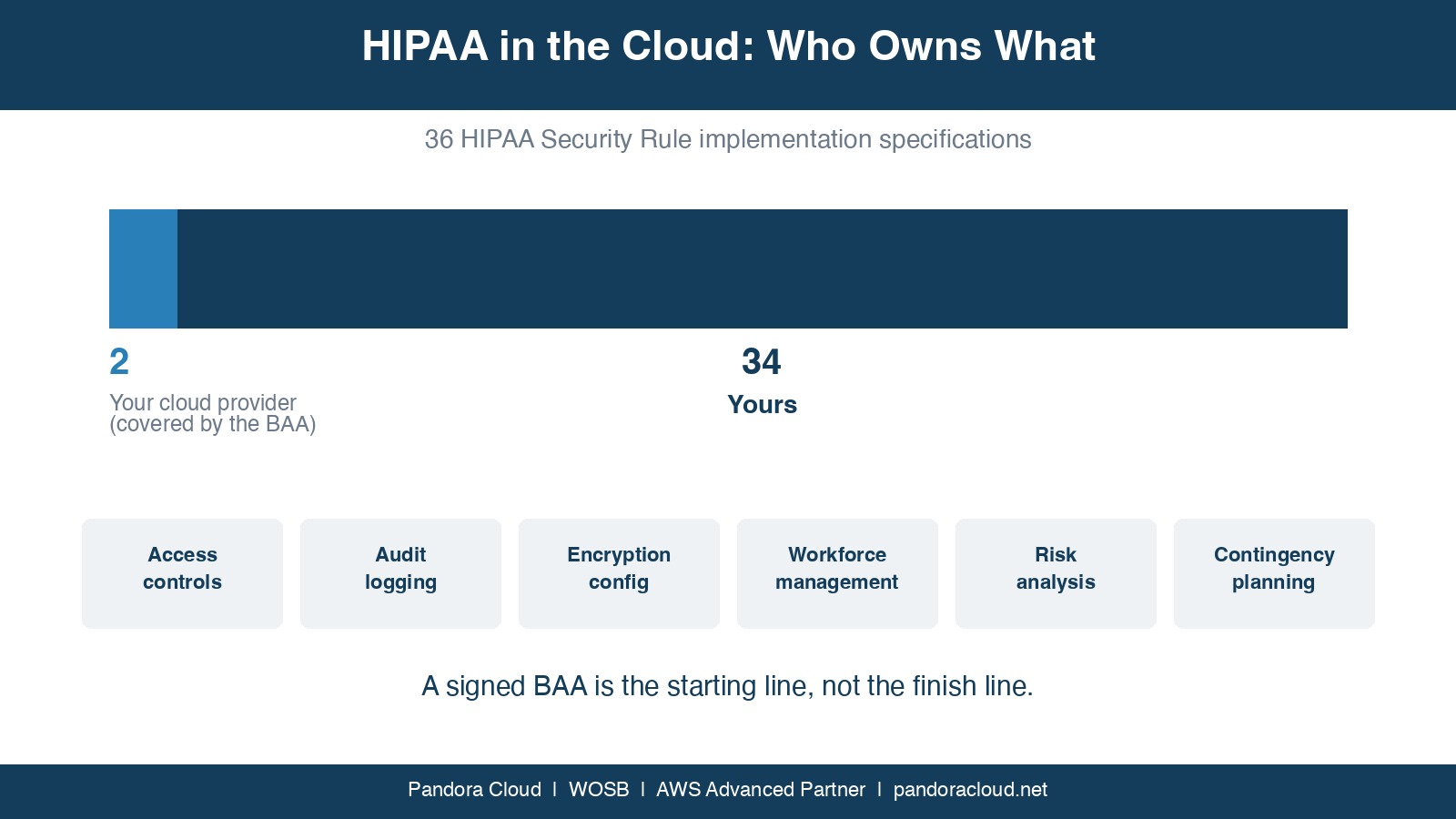
Access controls, audit logging, encryption configuration, workforce management, risk analysis, contingency planning, incident response: all of these live on the customer side of the line. The cloud provider gives you the building blocks. Assembling them into something an auditor accepts is what HIPAA in the cloud actually means.
What Are the Five Misconceptions That Show Up in Almost Every Audit?
The same misunderstandings about HIPAA in the cloud appear over and over when we work with healthcare SMBs. Each one feels reasonable on its own, and each one creates compliance gaps that auditors and regulators find quickly.
1. “We use HIPAA-eligible services, so we’re compliant.”
HIPAA-eligible is not the same as HIPAA-compliant. AWS, Azure, and Google Cloud each maintain a list of services that can be used to handle Protected Health Information (PHI) when configured correctly. Eligibility means the provider will sign a BAA covering that service. It says nothing about whether your specific configuration meets HIPAA requirements. A HIPAA-eligible database with public access enabled, weak credentials, and no encryption is still a HIPAA violation waiting to happen.
2. “Our electronic health record (EHR) vendor is HIPAA compliant, so we’re covered.”
Your EHR vendor’s compliance covers the EHR. It does not cover the spreadsheets your billing team exports, the email attachments your front desk forwards, the analytics platform your operations lead set up last quarter, or the file shares where prior authorization documents accumulate. PHI flows through your environment in dozens of channels beyond the EHR, and every one of those channels needs its own controls.
3. “We have a BAA with our cloud provider, that’s enough.”
The BAA is a legal document that allocates liability and obligates both parties to certain practices. It is necessary but not sufficient. The BAA does not configure your encryption, write your policies, manage your access reviews, or train your staff. Auditors look for evidence that the technical and administrative controls actually exist; the BAA is a single line item in a much longer checklist.
4. “HIPAA only applies to clinical data.”
PHI is far broader than most healthcare SMBs realize. Names tied to appointment dates, billing records, insurance identifiers, IP addresses linked to patient portals, even photos and voicemails: all of these can constitute PHI under HIPAA’s 18 identifiers. The implication is that your scheduling system, your billing platform, your support ticketing tool, and your call recording system probably all hold PHI, and they all need to be treated accordingly.
5. “We’re too small for the Office for Civil Rights (OCR) to audit us.”
OCR does not need to randomly select your practice to investigate it. A single complaint, a single breach notification, or a single tip from a former employee can trigger a full investigation. The enforcement record makes the point better than any warning does: OCR announced 21 settlements in 2025, the second-highest annual total on record, and its Risk Analysis Initiative had reached its thirteenth completed investigation by April 2026. Those cases were not academic medical centers. They were treatment centers, specialty practices, and small vendors whose entire compliance gap came down to a risk analysis they never finished. You can read the full enforcement history in OCR’s published resolution agreements.
What Are the Five Areas Where Healthcare SMBs Actually Have Gaps?
When we run a readiness assessment for HIPAA in the cloud, the same five categories produce the majority of findings for a healthcare SMB. None of these are obscure; all of them are achievable with the right structure.
Access controls and audit logging. HIPAA requires that you can answer, at any moment, who accessed which patient record and when. In practice, this means unique user accounts for every person who touches PHI, role-based permissions that actually reflect job duties, immutable audit logs, and regular reviews of access patterns for anomalies. The Security Rule requires HIPAA documentation to be retained for six years, and most auditors expect access logs to be available over a comparable window. Shared accounts, generic admin logins, and missing or rotated logs are the most common findings here.
Encryption of PHI at rest and in transit. The basic requirement sounds obvious, but the configuration details cause most failures. Encryption at rest with default keys is weaker than encryption with customer-managed keys. TLS 1.2 with weak cipher suites is not the same as TLS 1.3 with strong cipher suites. Backups are often forgotten in encryption policies, as are file shares, snapshot stores, and the temporary copies that applications generate during processing. Encryption is where HIPAA in the cloud most often fails on detail rather than intent.
Backup and disaster recovery for PHI. HIPAA requires both data backup and disaster recovery plans, and it requires that those plans are tested. A nightly backup that has never been restored, a disaster recovery runbook that has never been exercised, or a backup system that itself is not encrypted are common findings. HIPAA-grade backup means the backups are encrypted, geographically redundant, regularly tested, and themselves protected by the same access controls as the primary data.
Workforce access management. Terminations, role changes, contractor offboarding, and third-party vendor access are where access drift accumulates. Most healthcare SMBs can produce a list of current employees but cannot produce a list of every account that touched PHI in the last 12 months and confirm that each one is still authorized. Quarterly access reviews, automated deprovisioning, and a vendor inventory with active BAAs close most of these gaps.
Risk analysis and risk management. The Security Rule requires a risk analysis, and it is now the single most enforced provision in the rule. OCR built an entire enforcement initiative around it, and the pattern across those cases is consistent: the organization either had no risk analysis at all, or had one that never covered the systems where the breach actually happened. A real risk analysis identifies every system that handles PHI, evaluates threats and vulnerabilities for each, documents the existing controls, and produces a remediation plan for the gaps. It needs to be updated annually, after major system changes, and after any incident.
What Changes If the Proposed Security Rule Update Lands?
One thing has shifted since most healthcare SMBs last looked closely at their obligations. In January 2025, HHS published a notice of proposed rulemaking that would be the first substantive rewrite of the Security Rule since 2013. The comment period closed in March 2025 and drew more than 4,000 responses. As of August 2026 no final rule exists, and the federal regulatory agenda now targets July 2027 for final action, pushed back from an earlier 2026 estimate. Those dates are not binding and have already moved once.
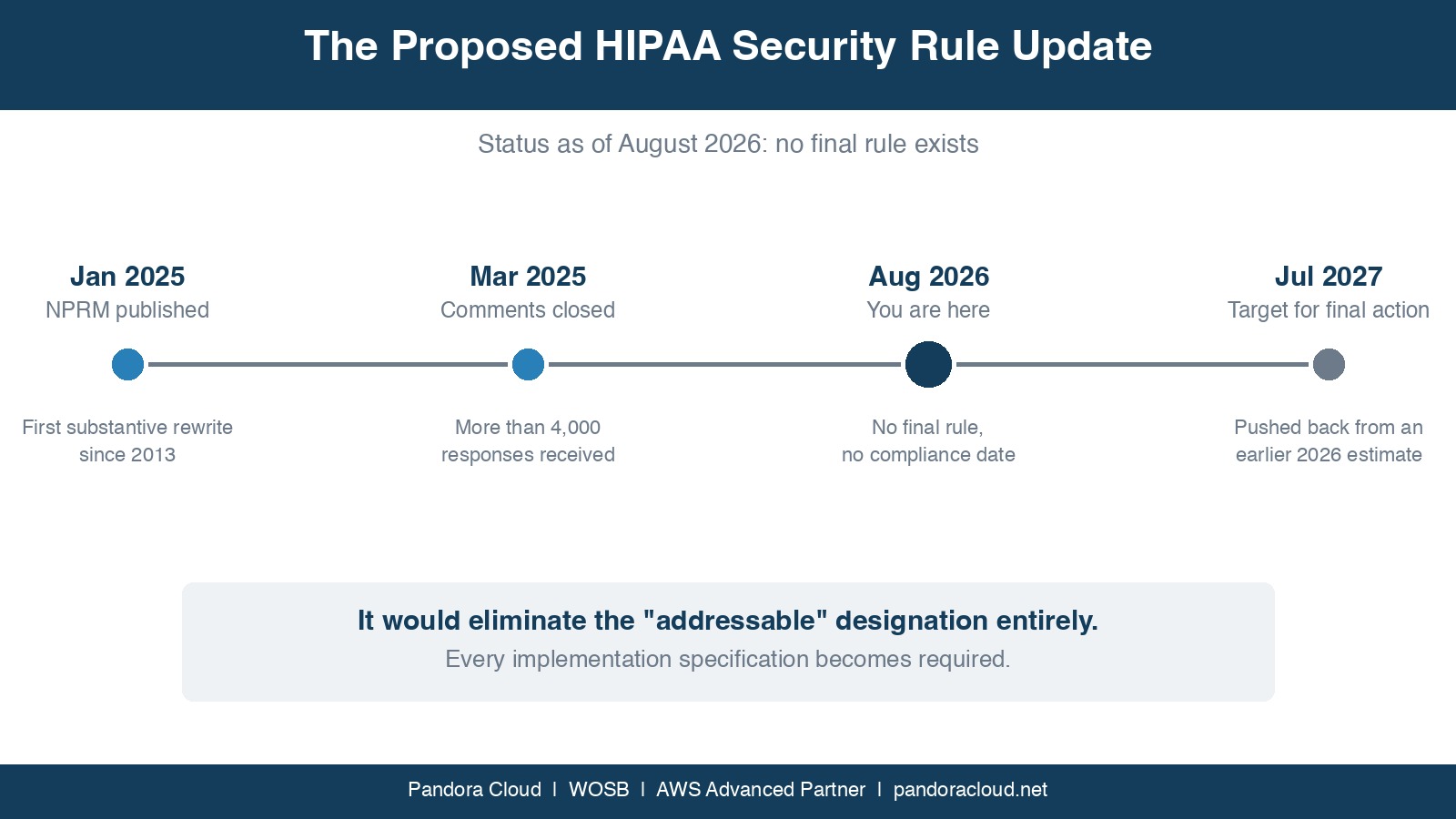
The proposal matters even in draft form, because of what it would remove. Today the Security Rule splits implementation specifications into “required” and “addressable,” and addressable has been widely misread as optional. The proposed rule eliminates that distinction and makes every specification required, while promoting several practices that currently sit in the best-practice category, including network segmentation, multi-factor authentication, and encryption, into explicit obligations. If it is finalized as written, compliance would be expected roughly 240 days after publication.
The practical read for a healthcare SMB is straightforward. Do not wait for the final rule, and do not rebuild anything around a draft. The controls the proposal would make mandatory are the same controls a competent HIPAA in the cloud program should already have in place, and they are the same ones OCR is citing in enforcement actions today. An organization that closes its current gaps is already most of the way to whatever the final rule requires.
What Is the Cost Reality for Healthcare SMBs?
The financial consequences of a HIPAA breach for a small healthcare organization can reach several million dollars when the full picture is counted: OCR civil monetary penalties, breach notification costs, credit monitoring for affected patients, legal fees, class action exposure, and the reputational damage that pulls patients toward competitors who never had a public incident.
That number is not an abstraction. Specialty practices, billing companies, and healthtech startups have closed because of a single non-compliance event. The cyber insurance market has tightened, and underwriters increasingly require evidence of HIPAA controls before they will issue a policy at all, much less pay a claim.
Compared to that exposure, the cost of building a structured program for HIPAA in the cloud is small and predictable. The hard part is not affording it; the hard part is recognizing that it has to be a program, not a checkbox, and getting started before something forces the issue.
How Do You Run HIPAA in the Cloud as a Program, Not a Checkbox?
The healthcare SMBs that handle HIPAA in the cloud well share a common pattern. They treat compliance as an operational function with named owners, documented procedures, regular cadences, and continuous evidence collection. They do not wait until an audit to ask whether their controls are working.
This usually means a few practical commitments. There is one person, internal or external, who is accountable for the HIPAA program. There is a written set of policies that map to the Security Rule, the Privacy Rule, and the Breach Notification Rule. There is a tooling layer that monitors configurations, logs access, and flags drift in real time. There is a calendar of recurring activities: access reviews, risk analysis updates, BAA inventories, training, and tabletop exercises.
For broader context on running compliance as an operational function rather than an annual scramble, our Compliance Program Blueprint walks through the structure that healthcare, finance, legal, and insurance SMBs use to keep multiple frameworks current at the same time.
Where Do You Get the HIPAA Cloud Compliance Checklist?
If you want a focused starting point for HIPAA in the cloud that is specific to cloud-based PHI handling, we built a free HIPAA Cloud Compliance Checklist for healthcare SMBs. It walks through the technical and administrative safeguards that most often produce findings during audits and breach investigations: access controls, encryption, audit logging, workforce management, vendor BAAs, backup and recovery, and risk analysis.
Each item is written for a healthcare SMB owner or operations lead, not for a security engineer. You can work through it with your team in an afternoon and come out the other side with a clear list of what is in place, what is partially in place, and what needs attention.
Download the free HIPAA Cloud Compliance Checklist
What Does HIPAA Compliance Actually Cost?
Under the 2026 inflation-adjusted tiers, HIPAA civil monetary penalties start at $145 per violation and the annual cap for repeated violations of a single provision reaches $2,190,294. Those are the visible costs. The hidden ones (audit prep scrambles, lost contracts, breach response, cyber insurance premium increases) usually exceed the fine itself. Our free Cost Calculator includes a Healthcare scenario that models the full proactive-versus-reactive picture for clinics, specialty practices, billing companies, and healthtech startups.
Key Takeaways
- A signed BAA from your cloud provider satisfies roughly 2 of the 36 HIPAA Security Rule implementation specifications; the remaining 34 belong to the customer, covering access controls, encryption configuration, audit logging, workforce management, and risk analysis.
- PHI under HIPAA’s 18 identifiers is broader than most healthcare SMBs realize: names tied to appointment dates, billing records, IP addresses linked to patient portals, and call recordings all qualify, meaning scheduling systems, billing platforms, and support tools are all in scope.
- Risk analysis is now the most enforced provision in the Security Rule. OCR announced 21 settlements in 2025 and reached the thirteenth completed investigation in its Risk Analysis Initiative by April 2026, with small providers heavily represented.
- The proposed Security Rule update would eliminate the “addressable” designation and make every implementation specification mandatory. Final action is currently targeted for July 2027, so build toward the controls now rather than waiting on the rule.
- Quarterly access reviews, automated deprovisioning, and an active vendor inventory with current BAAs close the majority of gaps that produce findings during HIPAA audits of healthcare SMBs.
Next Steps
HIPAA in the cloud is achievable for healthcare SMBs, but the path is structural, not accidental. The clinics, specialty practices, billing companies, and healthtech startups that get this right do so by treating HIPAA as a program from the beginning and building the cloud environment around it.
Pandora Cloud helps regulated SMBs in healthcare, finance, legal, and insurance build and maintain compliant cloud environments. We combine continuous monitoring with managed compliance services, so your team can focus on patients and operations while we handle the infrastructure and the evidence trail that HIPAA in the cloud depends on.
Take our free compliance assessment to see where your environment stands today, or let’s talk through your specific situation.
